
Keeper guide
Sexing your tarantula
The moult tells you for certain. Real exuvium photographs below show exactly where to look - then record the answer on your specimen.
🥇
Moult sexing is certain
Reading the exuvium is the only 100% method. Ventral guessing from above is maybe 80% - the moult is definitive.
🔬
Look between the book lungs
Both sexes show their structures in the same place: the epigastric furrow area between the front pair of book lungs.
📏
Size matters
Very small slings are hard to read even under a loupe. If you cannot see anything, wait a moult or two.
Step 1
The view you need
Flatten the dried exuvium abdomen-up so you are looking at the INSIDE. The four pale slits are the book lungs - the front pair frame the area where everything happens. The curved line between them is the epigastric furrow.
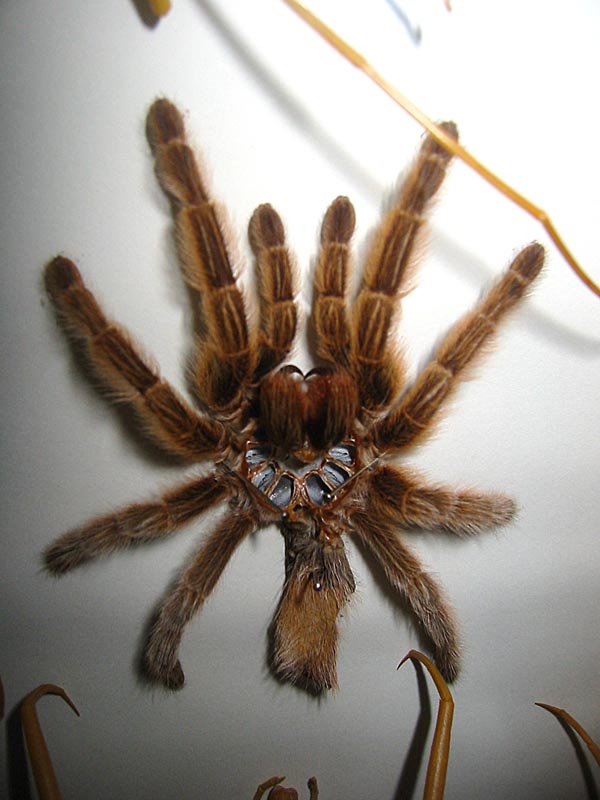
On this view, check two things
- 1 Above the furrow (towards the head): dark, rigid structures = female spermathecae
- 2 Below the furrow (towards the rear): a tiny bristle patch = male fusillae
Photo: tarantula exuvium, ventral view (Uwe Kils, Wikimedia Commons, CC BY-SA 3.0).
Step 2
Female: spermathecae
Dark, rigid, chitinous structures sitting above the epigastric furrow, between the front book lungs. This is where she stores sperm - it holds its shape out of the moult and looks almost machine-made.
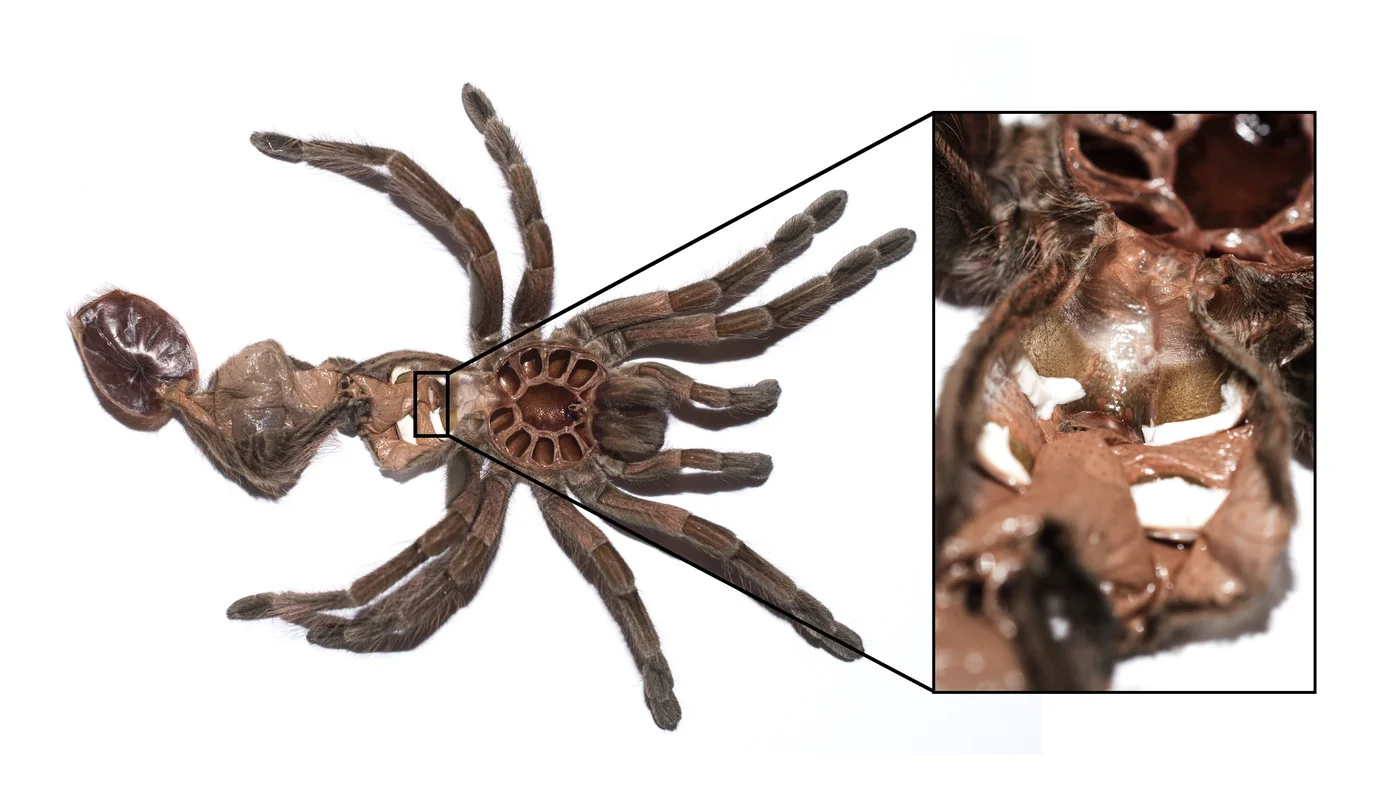
Annotated female exuvium - the spermatheca is highlighted where the arrow points, between the anterior book lungs (Oneillbeck, Wikimedia Commons, CC0).
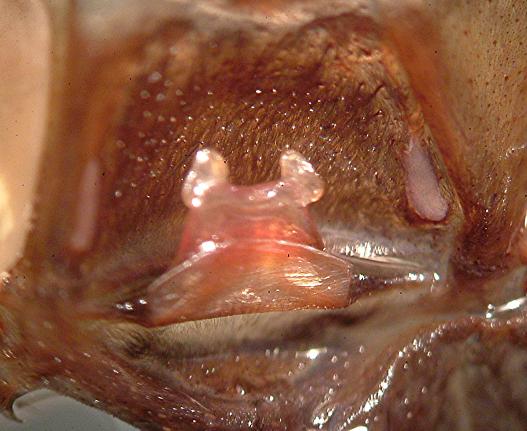
A. geniculata spermathecae under magnification - note the paired structure (Viki, Wikimedia Commons, CC BY-SA 3.0).
Shapes vary by family - all of these mean female
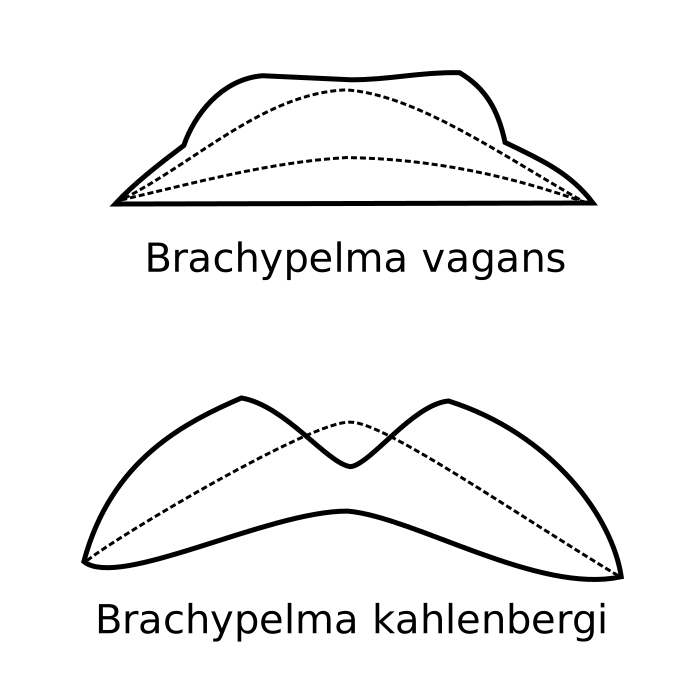
Scientific diagram: Tliltocatl vagans (fused) vs T. kahlenbergi (paired) (Micha L. Rieser, after Rudloff 2008, Wikimedia Commons, CC0).
- • New World terrestrials (Brachypelma, Grammostola, Aphonopelma): two separate fingers, or fused into one arch
- • Old World terrestrials (Hysterocrates, Pelinobius): long, paired, often curved outward
- • Avicularia-type: two soft rounded lobes close to the furrow
Step 3
Male: epiandrous fusillae
A small patch of tiny dark bristles just below the furrow, between the front book lungs. Males use them to spin the sperm web - females never have them. No freely-licensed macro photo exists yet, so this is a simplified schematic of what to hunt for:
- • To the naked eye it looks like a blurred dark smudge - a loupe or phone macro photo resolves it into individual hairs
- • Easier to spot on exuviae of 4cm+ DLS specimens
- • If you see fusillae, it is male. Done - nothing else to check
- • No fusillae AND no spermathecae? Immature specimen - recheck next moult
Mature males make all of this unnecessary - tibial hooks and bulbous pedipalps are visible from across the room.
More female examples
Spermathecae across species
Same structure, different shapes - once you have seen one, you will recognise them all.
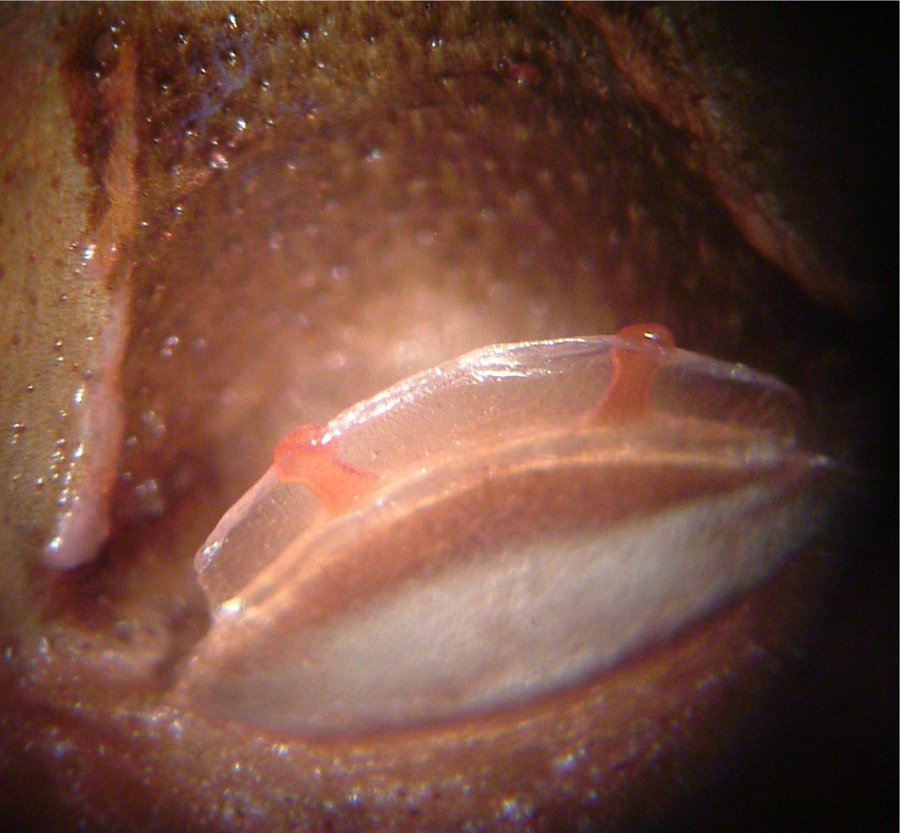
Grammostola rosea - the classic fused arch (Viki, Wikimedia Commons, CC BY-SA 3.0).
Acanthoscurria geniculata - clearly separated pair (Viki, Wikimedia Commons, CC BY-SA 3.0).
Check your own exuvium photo
Upload or drop a photo of your moult's epigastric area. It stays on your device - nothing is uploaded to any server. Hover to magnify and compare against the photos above.
🔬
Drop your exuvium photo here
or
Tip: photograph the INSIDE of the abdomen, flattened, with light behind it - the book lungs and furrow should all be in frame.
Your verdict
Common mistakes
- x Reading the moult right side up - structures are on the INSIDE (abdomen-up view)
- x Confusing book lung edges or the furrow itself for spermathecae - spermathecae are free-standing structures, not part of the fold
- x Declaring "female" because you cannot see fusillae - small males have faint patches; absence of one thing is not proof of the other
- x Trusting ventral markings over the moult - ventral patterns mislead constantly
- x Throwing the exuvium away before checking - every moult is a free, definitive sexing opportunity
Ventral sexing (the live guess)
With the spider standing, photograph between the front book lungs:
- • Males may show a dark smudge between the furrow and the book lungs - the fusillae through the skin
- • Females tend to have a wider, straighter furrow with clean skin around it
Treat ventral reading as a hint, never an answer - accuracy is roughly 80% at best, worse on juveniles. A moult confirms; ventral only suggests.